Making sense of their world
The primary years represent a distinct developmental stage in Montessori education. Children at this age are moving from the concrete, sensory learning of early childhood into a new phase of abstract reasoning, moral development, and social awareness.
The primary curriculum is specially designed for this stage of a child's development, nurturing their curiosity, critical thinking and a lifelong love of learning while helping them recognise their connection to the world and their ability to contribute to its future.
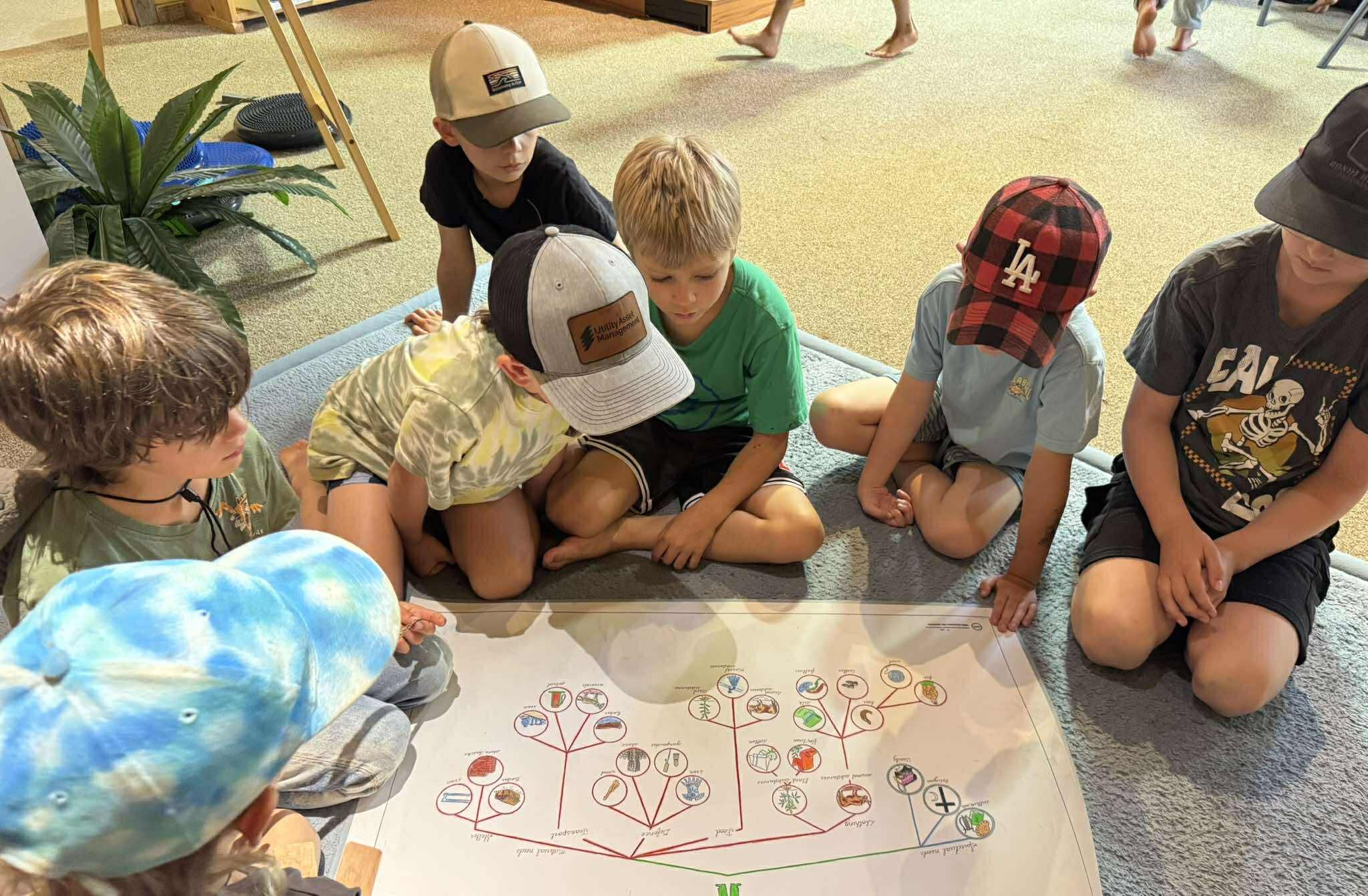
The 6 to 12 year old child
The Reasoning Mind
This child is hungry for knowledge and asks "why?" at every turn. They are developing their moral compass and are deeply interested in fairness and justice.
Concrete Montessori materials support the emerging reasoning mind, bridging the gap between concrete experience and abstract understanding.
Imagination
Through a powerful imagination, this child is ready to explore big ideas: the history of the universe, the laws of mathematics, and the complexity of human societies.
Research projects, community connections, and independent inquiry become pathways for discovering, questioning, and making meaning of the world.
Community
One of the most distinctive features of the 6 to 12 Montessori classroom is the emphasis on social development.
Children work in mixed-age groups, collaborate on projects, negotiate, and develop genuine friendships across year levels. The classroom is a small, functioning society.
Curriculum areas
The Great Stories
The foundation for Montessori primary learning is delivered through Great Stories. These introduce children to the interconnected nature of science, history, geography, art and language. Children are given a big-picture understanding of the world, inspiring them to ask questions, follow their interests and engage in independent research. Beginning with the formation of the universe and continuing through the evolution of life, humanity, writing and numbers, children develop a sense of wonder and curiosity about their place in the world.
Montessori is uniquely designed to bring this approach to life. Through a carefully prepared environment, expert guidance from trained educators and opportunities for independent exploration, children are supported to make meaningful connections, think deeply and follow their own pathways of discovery.
"The things that he sees are not just remembered, they form a part of his soul." – Dr Maria Montessori
The Montessori math curriculum is extremely visual and tactile. It moves from the concrete to the more abstract but always allows children the opportunity to manipulate materials to further absorb mathematical concepts and attain a deeper understanding. The materials are introduced at an early age to allow for indirect preparation for higher level concepts. The math curriculum also isolates concepts to their greatest simplicity to help children build on their knowledge as they work their way through materials. Geometry is also a large part of our math curriculum and is often interrelated with other subjects such as art and botany. The work in Geometry is arranged so that children can wherever possible discover the relationships, theorems and formulae themselves.
"Language is a city to the building of which every human being brought a stone." – Ralph Waldo Emerson
Language, reading and writing form a vital part of our curriculum and stretch across all subject areas. Wherever possible it is integrated and taught in context with an experience it relates to. Language is only taught as a separate subject when a child has to understand special points that centre around areas such as spelling, word study, handwriting, grammar and punctuation. Language is a means of human expression and we visit it in many different forms including dance, drama and music. Here at Meraki Montessori we are also lucky enough to experience other languages such as German or French and enjoy celebrating our bilingual heritage here in New Zealand by embracing Te Reo Maori throughout our day in the form of customs, language and cultural expression.
"The children and nature movement is fueled by this fundamental idea: the child in nature is an endangered species, and the health of children and the health of the Earth are inseparable." – Richard Louv
At Meraki Montessori we are fortunate to have an outdoor environment for children to interact with. Our Botany learning connects children with their surroundings through leaf shapes, ecology, classification, gardening and care for animals and the environment.
"Our task must be to free ourselves by widening our circle of compassion to embrace all living creatures." – Albert Einstein
At Meraki Montessori we are passionate about animals and the learning that can arise from having them included in our environment. We study the timeline of life and how animals evolved and the different classifications within the animal kingdoms. We also learn how to care for animals and what habitats and environments they live within.
"If I have seen further than others, it is by standing upon the shoulders of giants." – Isaac Newton
The study of history is closely tied to the study of geography and ignites in the child an empathy and gratitude for those who have come before us and what their impact might be on the future. History helps to provide context to other learning areas and holds many fascinating stories to help ignite the children's imagination. We study timelines on differing subjects, looking at calendars and how time and humanity's relationship with it has changed throughout history. We also learn to tell the time and study different civilisations that existed in our past and what we have learnt from them.
"To keep the body in good health is a duty... otherwise we shall not be able to keep our mind strong and clear." – Buddha
At Meraki Montessori we place great importance on good health and wellbeing because we know that this is essential for growth, development and learning. We view health as a holistic area, encompassing social, emotional, physical and spiritual learning. We foster an environment that values and encourages healthy eating, as we know that this nourishes the body. Our students learn to prepare and cook snacks for others by using practical life skills in the kitchen. We have an active sports programme that invites experts in the field to share their skills with the children, while encouraging daily exercise and activity. The children also visit the community to practise and learn skills that our school environment cannot cover, such as swimming and skiing at the local Snow Planet.
"The stars, earth, the stones, life of all kinds form a whole universe in relation with each other and so close is this relation, that we cannot understand a stone without some understanding of the great sun!" – Dr Maria Montessori
Being a scientist, Maria Montessori was very passionate about areas such as Geography being included in the primary curriculum. The study of Geography is made up of several different connecting areas including physical, political and economic geography and also a mapping and graphing perspective. Children learn about their universe, stories about how it formed, the planets that exist within it and the science that happens around us on a daily basis. They also do in-depth studies into countries and earth systems science.
"If we teach today as we taught yesterday, we rob our children of tomorrow." – John Dewey
Our approach to digital literacy is thoughtful and child-centred. We are committed to protecting the space for real, hands-on learning while helping children understand the world they are growing into. We're thinking carefully about the role that technology will play in our children's future.
Please ask us for our technology and AI policy or review our full policies and procedures.
A glimpse into daily life
We are committed to honouring Te Tiriti o Waitangi, weaving Te Reo Maori and tikanga into our daily life, and helping children develop a deep sense of belonging to this place in Aotearoa.